Mechanical & fabrication · 2021
Voronoi pen box
The piece I made to find out what my newly built CNC could actually do — 3D toolpaths, and whether it would cut aluminium at all.
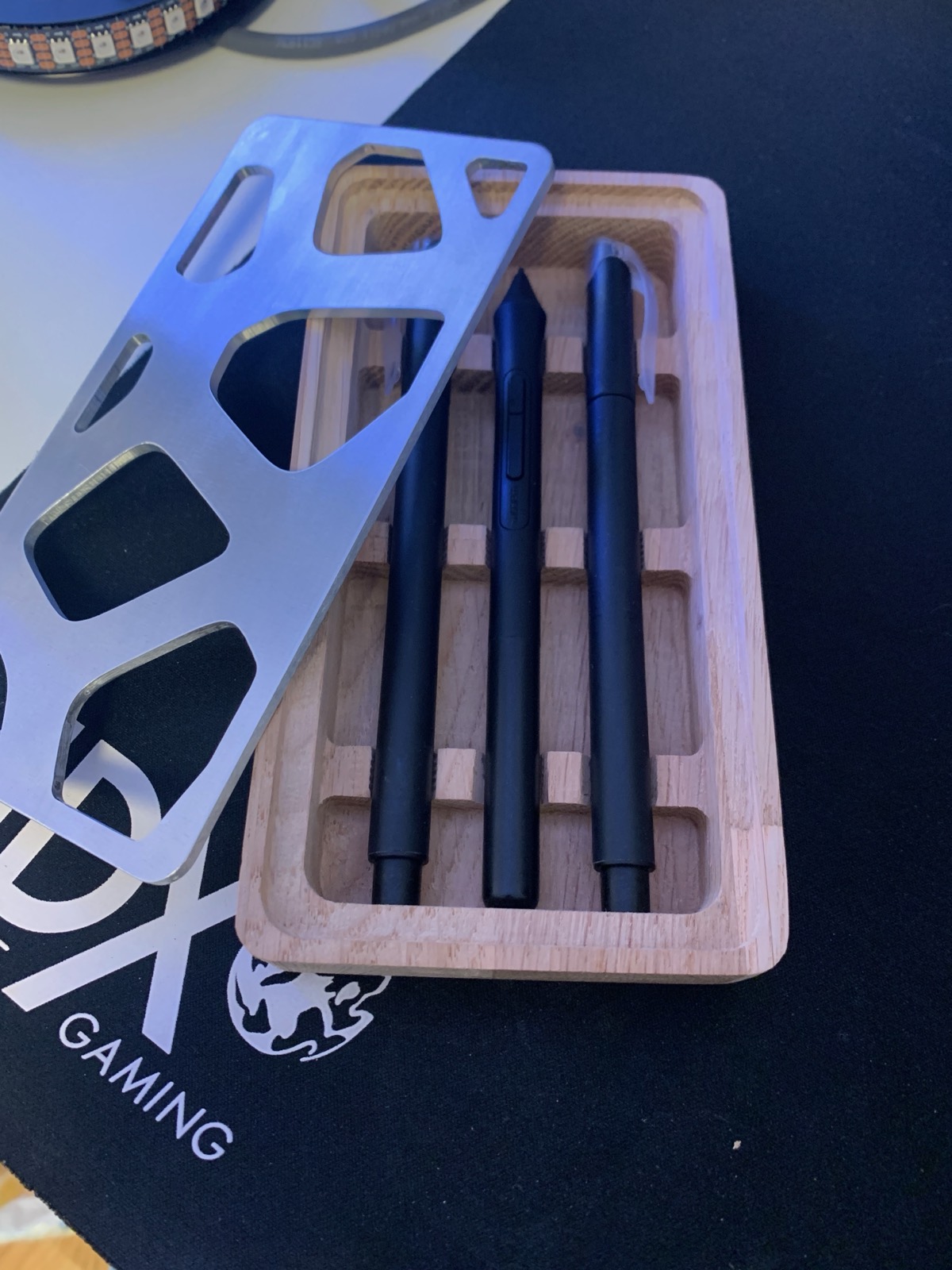
When I had finished building the Ooznest CNC, I needed something to build with it — not a part I needed, but a part that would tell me what the machine could do. A pen box turned out to be a good excuse.
What I was actually testing
Three things, none of them about pens:
- Different toolpath strategies, to see how each behaved on a real part rather than in simulation.
- 3D toolpaths specifically — everything up to that point had been flat 2D profiling and pocketing.
- Whether the machine would cut aluminium. A hobby CNC that handles wood comfortably will not necessarily handle metal, and there is no way to find out on paper. Rigidity, feeds, chip clearing and how much the frame flexes under load all show up in the finish, or in a broken cutter.
The Voronoi lid
The lid is aluminium, with a Voronoi pattern cut clean through it — cells that look like leaf veins or the way cracks spread, which is the point: Voronoi tessellations turn up throughout nature, so the pattern reads as organic even though it is entirely computed.
I generated it with a Python script running inside Fusion 360 rather than drawing it. That is the part I would still defend: a pattern with that many irregular cells is miserable to draw by hand and trivial to generate, and once it is generated you can change the cell count or density and get a new lid without redrawing anything.
Cut through the plate, the cells make the lid a window — the wood of the tray shows through the gaps, so the two materials work together rather than the metal simply sitting on top.
How it went
Well enough that I kept using the machine for aluminium afterwards, which was the answer I was looking for. The box has been holding pens ever since.