Robotics & vehicles · 2025–2026
Ligmax
A self-stabilising autonomous trimaran, built by two people and raced at Njord 2026 against teams many times our size.
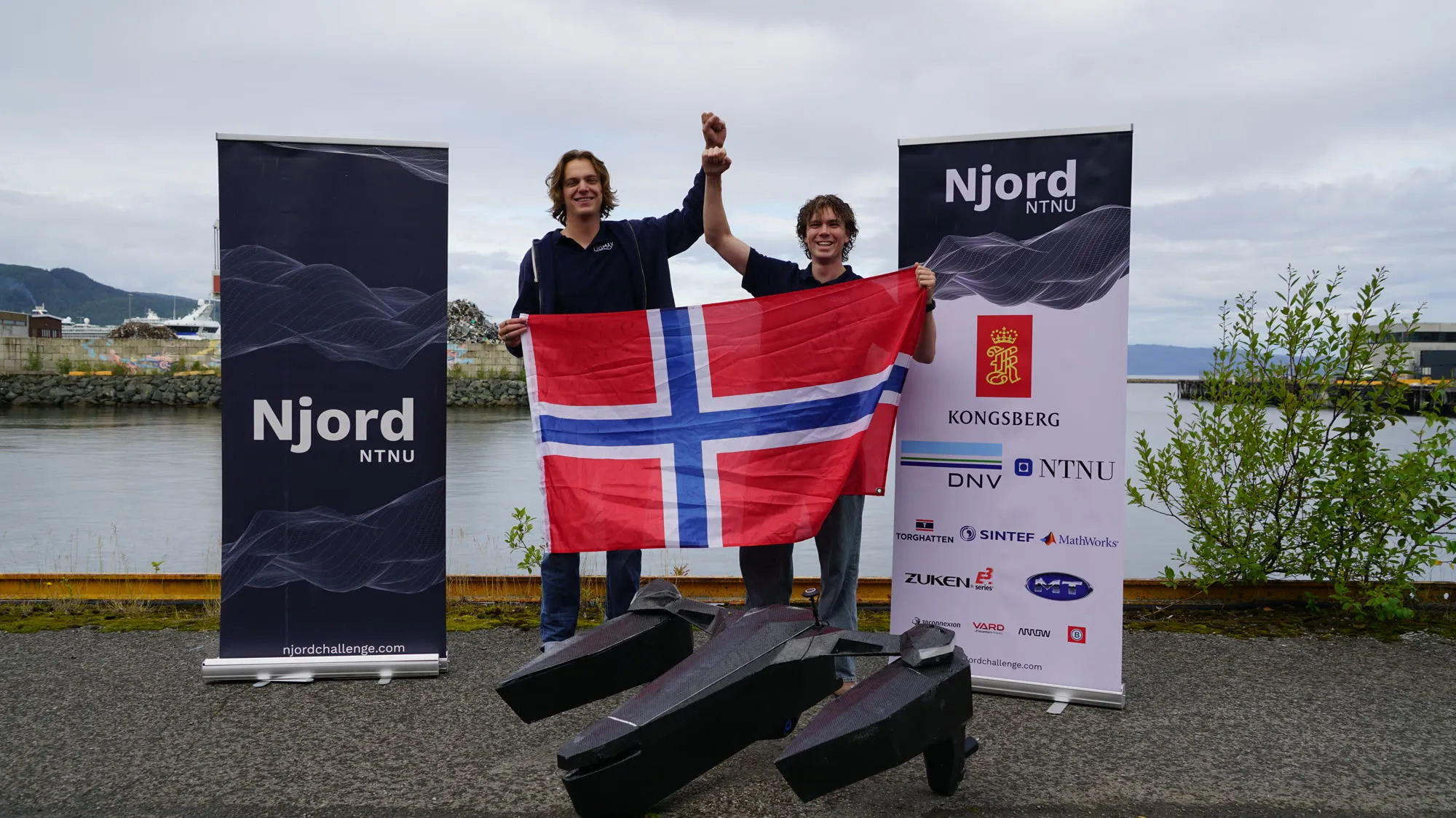
Ligmax is an autonomous surface vessel — a self-stabilising trimaran — that Andreas Lindeman and I built as our own team and raced at the Njord Autonomous Ship Challenge 2026 in Trondheim.
I had joined Marinor, NTNU's autonomous boat organisation, in October 2025 and was doing a lot of the hardware on their vessel. Andreas was not part of Marinor. By that Christmas we had decided to enter the same competition ourselves, which meant building a complete autonomous boat as a team of two, against entrants with a full organisation behind them — and starting from nothing, months after everyone else.
| Propulsion | ≈5 kW |
| Battery | 1.8 kWh pack |
| Perception | 2 × 360° lidar, 2 × 220° cameras |
| Hull | 3D-printed core, carbon-fibre skinned |
Stabilised mechanically, not in software
Most student vessels correct for waves in software. Ligmax does it mechanically first, so the autonomy stack works from a platform that is already level instead of fighting the sea on its own. Three things move: actuated outriggers control roll, a gimbal holds the lidar steady, and the battery slides fore and aft to trim pitch.
That last one is why the pack is the shape it is. It is not a brick bolted to the floor — it is a moving mass in a control loop, which sets its geometry, its mounting, and how much slack the main cables need.
What I did
The electrical side: the battery system, power distribution, and the hardware everything else hangs off. I built the pack from cells up — spot-welded nickel busbars, a DALY BMS, and an enclosure that had to survive being a moving part.
On a boat the unglamorous things decide whether you finish. A pack that behaves predictably, a harness that survives vibration and salt water, and connectors you can still get apart when something has to be fixed on a slipway an hour before a run.
Njord 2026: the boat sank on day one
On the first day of testing the Pixhawk lost its settings. The main thrusters were no longer configured as bidirectional, so the moment we armed the boat they went to full reverse and pulled it under with everything aboard.
We got it out, stripped it, and flushed every part with fresh water and electronic cleaner. We ran the opening round the next morning, roughly twenty-four hours after pulling a flooded boat out of the fjord, and placed fourth.
Then the seawater kept working. Oxidation spread through the electronics for the rest of the week and took parts out one at a time. Both 360° lidars were dead for good, and the BMS — my subsystem — went with them. We clawed the boat back part by part between runs and finished fourteenth.
The lesson was not about capability. The tasks were easier than we expected going in; we simply could not keep the hardware alive long enough to run them. That is a durability problem, and durability is an electrical and mechanical design choice you make months earlier.
The full account is on ligmax.no, along with a technical report.
What it became
The team carried on and became Dialga — still the two of us. Its second-generation vessel is Mobula, for Njord 2027.